
I agree Our site saves small pieces of text information (cookies) on your device in order to deliver better content and for statistical purposes. You can disable the usage of cookies by changing the settings of your browser. By browsing our website without changing the browser settings you grant us permission to store that information on your device.
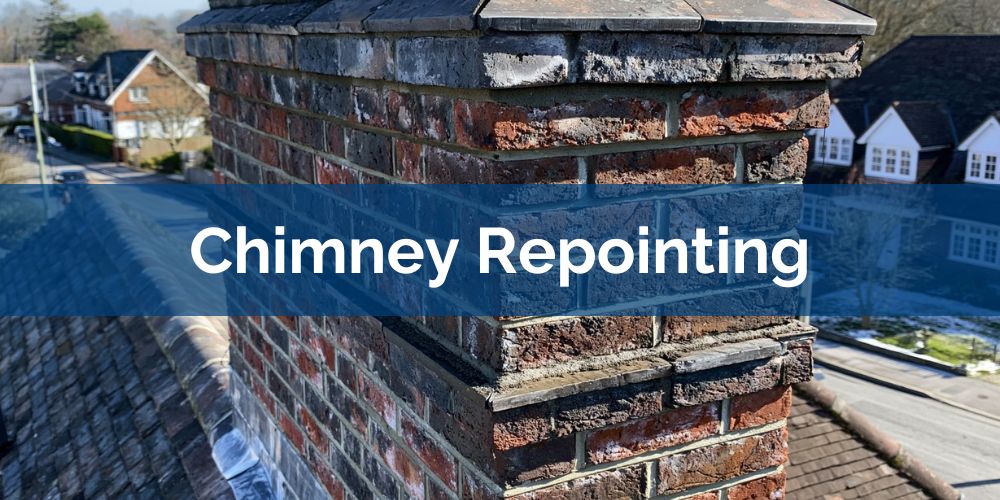
Raynes Roofing provides chimney repointing in Woking for chimney stacks with cracked, loose, recessed or deteriorated mortar joints. Repointing removes defective mortar from between serviceable bricks and replaces it with an appropriate new mortar to restore the joints while retaining the existing chimney masonry.
Chimney repointing should be based on the condition of both the mortar and the bricks. If deterioration is confined to the joints, repointing may be sufficient. If bricks are extensively damaged, sections of masonry are loose or the stack has become unstable, the work can instead require brick replacement or partial rebuilding.
Deteriorated mortar + sound masonry → repointing.
Local brick failure + sound surrounding stack → brick replacement + repointing.
Widespread masonry deterioration → partial or complete rebuilding.
Chimney repointing is the renewal of deteriorated mortar joints between the bricks or masonry units forming a chimney stack. Defective mortar is removed back to a suitable repair depth and new compatible mortar is placed into the prepared joints.
The objective is not to coat the face of old mortar with a thin new layer. Effective repointing requires the replacement mortar to form a durable joint between sound masonry edges.
Historic England specifically warns that unsuitable repointing can damage both the appearance and durability of masonry and advises that sound existing mortar should normally be left undisturbed rather than unnecessarily removed.
This creates an important scope rule:
failed mortar → remove;
sound mortar → retain;
defective brick → repair or replace separately.
Mortar forms the joints between the individual bricks or masonry units within the chimney stack. Those joints allow the separate units to function as one masonry assembly while closing the spaces between them.
On an exposed chimney, mortar joints are subjected to weather on several faces of the stack. Once the exposed joint deteriorates sufficiently, the edges can become recessed, cracked or loose and the surrounding masonry receives less protection.
The chimney should therefore be considered as a connected assembly:
brick + mortar joint + adjoining brick → masonry stack.
Repointing restores the joint within that assembly. It does not repair every possible defect associated with a chimney.
A chimney should be assessed for repointing when mortar joints are visibly deteriorating but enough sound brickwork remains for the stack to be retained.
Relevant signs include:
These signs identify deterioration, but they do not automatically prove that repointing alone is sufficient. The surrounding bricks and overall stability of the stack still need to be assessed.
Chimney mortar can deteriorate through several interacting mechanisms:
The useful diagnostic relationship is:
visible mortar failure → identify why the joint failed → assess masonry → specify compatible repair.
This is more reliable than assuming every failed joint simply needs a stronger mortar.
A chimney repointing assessment should establish whether deterioration is confined to the mortar joints or extends into the masonry and associated chimney details.
This prevents a repointing quotation from being based solely on the visible front face of the stack while defects continue on its less accessible elevations.
Chimney repointing involves removing failed mortar without unnecessarily damaging the surrounding brickwork, preparing the joints and installing compatible replacement mortar.
A typical repair sequence is:
Historic England's guidance emphasises careful removal of failed pointing without damaging masonry and appropriate matching of repair material and finish on historic buildings.
No. Sound mortar should not be removed simply because another part of the chimney requires repointing. The repair boundary should correspond to actual deterioration.
Historic England states that comprehensive repointing is rarely necessary and that sound historic mortar should generally remain undisturbed.
The correct distinction is:
sound, well-bonded joint → retain;
loose or deteriorated joint → rake out and repoint;
mixed condition → repair only the defective areas where a coherent local repair can be achieved.
If deterioration is distributed throughout most of the stack, the scope can legitimately become extensive. That conclusion should follow the condition assessment rather than an assumption that every visible joint must automatically be replaced.
The appropriate rake-out depth is the depth required to remove defective material and expose a suitable joint for the replacement mortar without unnecessarily damaging the brickwork.
A fixed depth should not be used as a substitute for assessing the existing mortar because joint dimensions, masonry condition and previous repairs vary between chimneys.
The functional sequence is:
remove loose mortar → reach suitably sound retained material → clean joint → install new mortar to an adequate working depth.
If the joint continues to crumble significantly deeper than expected, this can indicate that the deterioration is more extensive than a superficial repointing repair.
Applying a thin layer of new mortar over loose or deteriorated existing pointing is not equivalent to repointing. The new material needs a suitable prepared joint rather than an unstable surface layer.
The distinction is:
surface patch over failed mortar → underlying defect remains;
defective mortar removed + sound repair depth established → new joint can be formed.
This helps explain why some previous chimney pointing appears satisfactory initially but later separates from the stack. If the material beneath the repair remains loose, the new outer layer has no reliable substrate.
The mortar should be compatible with the existing bricks, original mortar and exposure of the chimney rather than selected simply for maximum hardness or strength.
The correct material can differ between properties. Older buildings may contain traditional lime-based mortars, while other chimneys may have been constructed with different mortar systems. Historic England advises that repair materials on historic masonry should be selected for compatibility and notes that chimney repointing on listed buildings should match the existing material, including lime mortar where lime has been used.
The specification therefore follows:
existing masonry + original mortar + joint condition + exposure → compatible replacement mortar.
This is preferable to treating one mortar formulation as universally correct for every Woking chimney.
Not necessarily. Mortar should work compatibly with the masonry around it rather than simply being made as hard as possible.
Historic England warns that unsuitable repointing can adversely affect the durability of masonry. This is particularly relevant where older or relatively soft bricks remain in place.
The repair objective is therefore not:
weak old mortar → install strongest possible replacement.
It is:
identify existing construction → remove failed material → select compatible mortar → preserve serviceable masonry.
A mortar specification should consequently be based on the chimney being repaired rather than a generic preference for cement-rich or lime-rich material.
Repointing can stop water penetration where deteriorated mortar joints are the actual route through which moisture is entering the chimney masonry. It will not stop a leak caused by another component.
Water appearing beside a chimney can originate from:
The diagnostic sequence should therefore be:
internal damp near chimney → inspect masonry + chimney top + roof junction → establish water path → repair failed component.
Repointing a chimney with sound joints will not correct defective flashing, just as replacing flashing will not restore open masonry joints above it.
Chimney repointing repairs mortar joints within the masonry stack. Flashing repair restores the weatherproof junction between the chimney and the roof covering.
They occupy different parts of the same chimney assembly:
brick-to-brick junction → mortar pointing;
chimney-to-roof junction → flashing, soakers, apron and back gutter.
Both defects can produce damp around a chimney, which is why diagnosis matters before the repair scope is selected.
A chimney can require both services where the masonry and roof junction have deteriorated independently, but one should not be sold as a substitute for the other.
Chimney repointing repairs the joints between bricks. Flaunching forms the mortar detail around chimney pots at the top of the stack.
The two mortar applications therefore perform different functions:
pointing → joints within chimney masonry;
flaunching → top-of-stack detail surrounding chimney pots.
If both areas have deteriorated, they can be repaired within the same chimney project, but cracked flaunching should not be described as failed pointing and defective wall joints should not be repaired simply by renewing the chimney top.
No. Chimney repointing concerns mortar joints between the bricks or masonry units of a chimney stack. Roof pointing normally concerns exposed mortar around traditionally mortar-bedded roof components such as ridge, hip or verge details.
The distinction is:
chimney brick joints → chimney repointing;
ridge or hip mortar → roof pointing;
mortar beneath loose ridge or hip tiles → roof rebedding.
This matters because each repair involves a different component and failure mechanism even though all may involve mortar.
Yes. Local brick replacement can be incorporated where individual masonry units have deteriorated beyond reliable retention but the surrounding chimney remains serviceable.
The repair hierarchy is:
sound brick + failed mortar → repoint joint;
isolated defective brick → replace brick + reinstate surrounding joints;
group of unstable bricks → locally rebuild affected masonry;
widespread deterioration → assess partial or complete chimney rebuilding.
The presence of one damaged brick therefore does not automatically mean the entire stack needs rebuilding, while repointing should not be used to hold together masonry that has already lost structural integrity.
Repointing becomes unsuitable where deterioration extends beyond the mortar joints into masonry that can no longer provide a stable retained chimney.
Broader repair should be considered where:
The threshold is therefore:
joint failure → repoint;
joint failure + isolated masonry defects → repoint + local brick repair;
local masonry instability → partial rebuild;
widespread stack failure → complete rebuild or removal assessment.
Yes. Local chimney repointing is appropriate where deterioration is confined to a defined area and the surrounding joints remain sound.
For example, one face of a chimney can deteriorate faster than another because different elevations experience different exposure. There is no technical benefit in removing serviceable mortar solely to make the repair area larger.
The repair boundary should instead follow condition:
isolated joints → local repair;
one deteriorated elevation → repoint affected elevation;
deterioration around most of stack → wider repointing;
masonry failure as well as joint failure → expand scope beyond repointing.
This approach also preserves sound existing fabric, which Historic England identifies as preferable when dealing with older masonry.
Yes, where the chimney pots and flaunching are stable and the required work is confined to the masonry joints below them.
Pot removal is not inherently part of chimney repointing. It becomes relevant where:
This keeps the project proportional: repair the defective mortar without dismantling sound chimney-top components unnecessarily.
A redundant chimney can still be repointed and retained where the masonry remains suitable and there is a reason to preserve the stack. Removal becomes an alternative when the chimney has no continuing function and its condition creates a disproportionate future maintenance requirement.
The decision should compare:
local mortar deterioration + otherwise sound stack → repoint;
significant repair requirement + chimney worth retaining → rebuild or wider repair;
redundant chimney + extensive deterioration → compare rebuilding with stack removal.
Removal is a separate project because it requires the chimney to be dismantled and the roof reconstructed where the stack previously penetrated it.
Routine like-for-like chimney repointing will normally be maintenance rather than a material alteration to the building, but the property's planning and heritage status should still be considered where relevant. National Planning Portal guidance treats external chimney alterations as capable of falling within permitted development subject to the applicable conditions and restrictions.
Woking Borough Council currently identifies 27 conservation areas with special architectural or historic interest, so locally protected settings can require additional consideration where work would materially alter the character or appearance of a chimney.
The distinction is:
like-for-like mortar repair → routine maintenance in ordinary circumstances;
material alteration to chimney form, detailing or appearance → planning position should be checked;
listed building → historic fabric and listed-building requirements need separate consideration.
Yes, but the repair needs particular attention to retention of historic fabric and compatibility with the existing mortar and joint appearance.
Historic England states that careful removal of defective pointing and repointing to match the original material, texture, quality, colour and finish will not generally require listed building consent where the work does not affect the building's special interest. Its guidance specifically identifies chimney repointing using material matching the existing construction, including lime mortar where lime mortar was originally used.
That does not mean every intervention on every listed chimney is automatically consent-free. More substantial alteration, inappropriate material changes or chimney dismantling can affect significance and require a different consent assessment.
The conservation principle is:
retain sound historic material → remove only failed pointing → match compatible repair → preserve established joint character.
Chimney repointing is high-level roof work, even when the mortar repair itself is relatively small. HSE states that all roof work is potentially dangerous and must be properly organised and planned, with appropriate controls for falls, roof edges and access.
The access requirement depends on:
A repair involving only a few mortar joints can therefore still require substantial access arrangements because the work location, rather than the amount of mortar used, determines much of the working-at-height risk.
The repointing scope should extend across the joints that have genuinely deteriorated while preserving sound mortar and identifying masonry defects that require separate repair.
This produces a condition-led specification:
joint condition + brick condition + mortar compatibility + associated defects → repointing scope.
A completed repointing repair should be assessed as part of the chimney rather than only by whether the new mortar appears neat.
Relevant checks include:
The completion criterion is therefore serviceable masonry joints integrated with sound retained chimney fabric, not simply a uniform new colour across the stack.
Raynes Roofing assesses chimney pointing together with the condition of the bricks, chimney-top details and surrounding roof junction so that deteriorated mortar is distinguished from defects requiring a different repair.
This allows the scope to remain proportional:
failed joint → repoint;
failed brick → replace locally;
failed flashing → repair the roof junction;
failed flaunching → repair the chimney top;
unstable masonry → rebuild rather than point over the problem.
Raynes Roofing has been established for more than 45 years and offers guarantees covering its roofing workmanship and applicable roofing materials.
If the mortar joints in your chimney are cracked, missing, loose or heavily weathered, contact Raynes Roofing for chimney repointing in Woking. The stack can be assessed to establish whether the deterioration is confined to the pointing or whether damaged brickwork, flaunching, leadwork or wider masonry repairs also need to be addressed.
Call 01483 475141 or contact Raynes Roofing for advice or a quotation for chimney repointing in Woking.